The “dark heart” of government
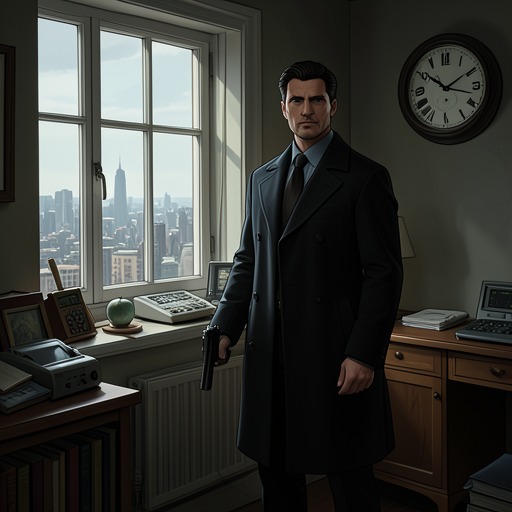
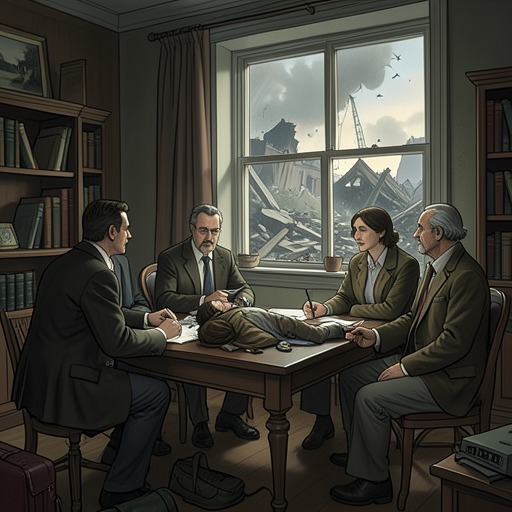
Down Cemetery RoadThe “dark heart” of government is the covert violence concealed beneath the ordinary workings of democratic government: a secret power justified as protection against terror and disorder, but capable of treating exposure itself as a reason to silence people. Recalled by Amos Crane during a train journey, the doctrine makes the preservation of public calm depend on keeping political realities hidden—and on making deliberate interventions look like accidents.
The doctrine of concealed power
When the Department recruited Crane, a senior official explained that democracy could possess a hidden, coercive capacity without openly governing through terror. The distinction rested on concealment: death squads were associated with fascism, whereas in a democracy, accidents happened. The language does not deny the violence; it redescribes it, separating the state’s public identity from the methods used to protect it.
Crane already understood the underlying logic. His secret, as the recollection puts it, was that he did not need the lecture. He nevertheless sat through it, nodded, and performed the role of a young recruit absorbing difficult lessons. The scene establishes the doctrine not as an abstract principle imposed on an innocent novice, but as a shared practical knowledge that the institution teaches and Crane already possesses.
Accidents as political management
The examples make the doctrine’s euphemism concrete. A minor royal might be allowed to fall while getting out of a shower, the official argued, rather than risk the royal family’s collapse. The resulting obituaries could turn the dead figure into an almost saintly lost possibility; the nation would mourn, remain undisturbed by the underlying realities, and eventually forget. The political purpose was to keep the boat from being rocked, not to establish justice or make the truth public.
The same reasoning applies to information. An official who learns that American air bases in Britain hold weapons whose presence has not been disclosed to elected representatives may be treated as a threat to secrecy even if his loyalty is unquestioned and there is no evidence he intends to act on what he knows. An icy road can then supply the appearance of accident. In this logic, possession of troublesome facts is enough: whether the holder is innocent matters less than whether the information remains concealed.
Crane as practitioner
The train recollection links the doctrine to Crane’s career. At twenty-three, he entered the Department’s world of expedient operations, where silencing an embarrassment did not always require killing: photographs, money, drugs, surgery, and sexual kompromat could also be used. But Crane was sometimes permitted to act more directly, and the narrative presents his talent as evident in those operations.
When an East End pimp obtained photographs of the Foreign Secretary in a compromising situation involving pre-teen girls, Crane applied the ABC principle by killing the pimp and eight other hustlers within two days. The resulting editorials described a gangland war, muffling serious investigation. The operation illustrates the doctrine’s double movement: violence removes people who might expose a scandal, while a manufactured public explanation helps contain scrutiny.
Crane’s proposed alternative sharpens the irony. He initially suggested that killing the Foreign Secretary would be cheaper and simpler than eliminating the blackmail threat. Howard’s predecessor treated the suggestion as a joke, and Crane pretended to do the same after recognizing which response was expected. The exchange shows how the Department’s limits are communicated through performance as much as explicit orders: the institution can tolerate ruthless reasoning, provided it is presented in an acceptable form.
Secrecy, legitimacy, and cost
The doctrine defines democratic legitimacy through the management of appearances. The public is allowed to mourn a sanitized story, while the state preserves its authority by withholding the facts that might disturb that response. Its claim to be different from fascism rests on the form of the violence—covert, deniable, and disguised as mishap—rather than on the absence of violence itself.
That logic also makes innocence precarious. A civil servant’s loyalty does not protect him if knowledge threatens disclosure; the institution’s priority is that secrecy remain intact. Crane’s recollection therefore exposes the dark heart as more than a set of covert techniques: it is a system of priorities in which political stability and institutional discretion can outweigh truth, accountability, and the lives of those made inconvenient.